

Fantasy Worldbuilding in Anime
talking about the intersection of my two favorite things

After doing my “Basic Guides” to Fantasy and Anime, I thought now would be a good time to talk some more about how these two topics interact. Specifically, I want to talk about some of my favorite fantasy settings in anime, highlighting series that I think have really intricate and well-crafted worlds. I’m going to be looking into what makes each setting unique, the creator’s approach to worldbuilding, and my personal favorite aspects of each world.
This post will include discussions of: Frieren: Beyond Journey’s End, Delicious in Dungeon, One Piece, Fullmetal Alchemist: Brotherhood, Hunter x Hunter (the 2011 anime specifically), Chainsaw Man, and Re:ZERO — Starting Life in Another World. None of these are anime originals, but I’m going to be sticking mostly to their anime and bring up the source material as little as possible. I will also try to keep spoilers at a minimum, but read at your own risk.
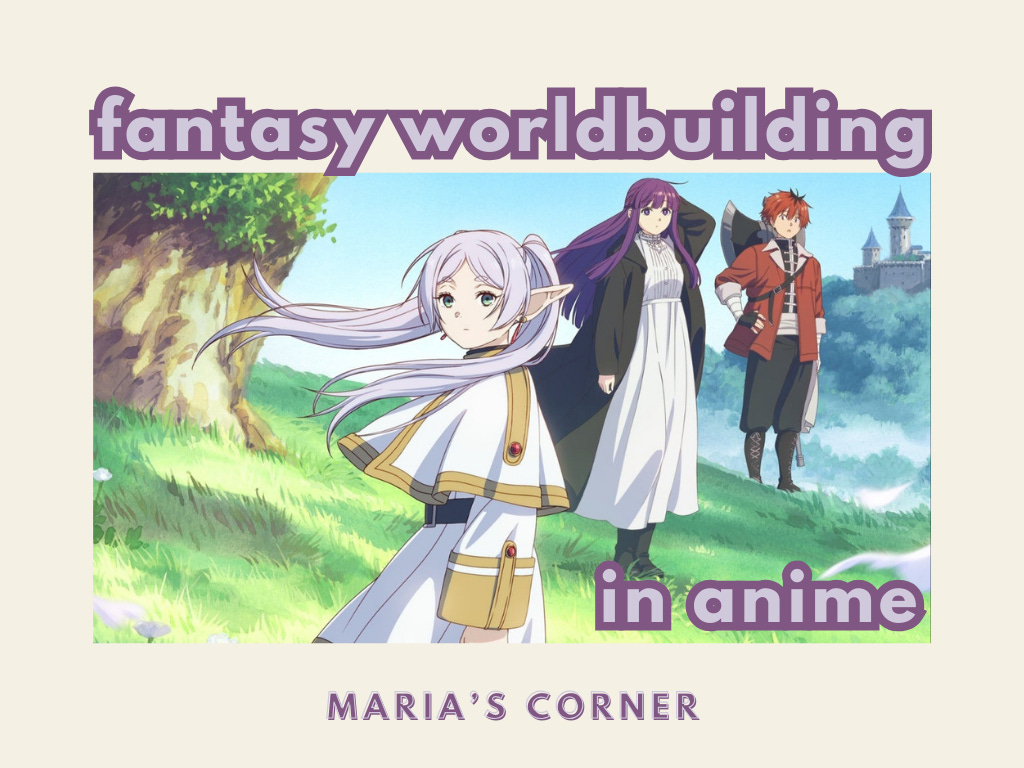
Frieren: Beyond Journey’s End.
Sometimes, simple is better. At first glance, the world of Frieren is exactly what you picture when you think of “stereotypical” fantasy: vaguely medieval, with chivalrous sword-wielding warriors, elves, dwarves and dragons. The setting is not the main focus of the story, so we are presented with a world that is familiar and easy to understand.
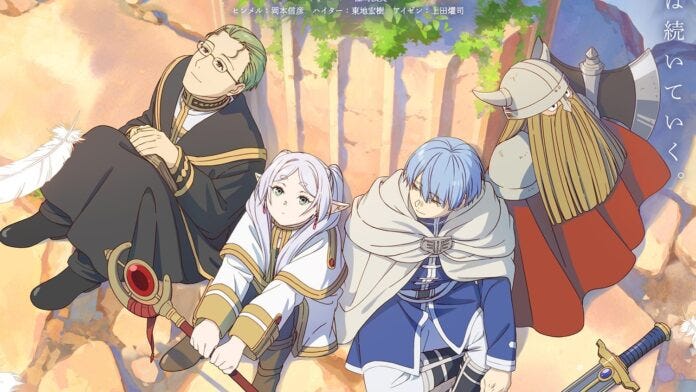
The show is more concerned with time and how our main character perceives its passage. As an elf who has been alive for over a thousand years, Frieren doesn’t really feel the difference between a day and a year. Great spans of time are blended together in a blur of memories, while other periods of her life are remembered in full detail, each day with her friends a precious memory that remains fresh in her mind despite the years. How is this translated into the setting?
While on the surface the show fits into the vaguely medieval aesthetic associated with fantasy, overtime it becomes clear that the setting is very anachronistic. This is somewhat common in fantasy literature, we often see worlds that are supposedly medieval but have many historical inaccuracies, but in Frieren it goes beyond that. The show has a unique aesthetic that mixes many different time periods, which I believe reflects how Frieren sees the world. To her, everything is both always the same and always changing, the evolution of human society happens too fast for her to notice or care. Because of this, modern clothing can coexist with plate armor without looking out of place.
The worldbuilding in Frieren is not as important as the characters and the themes of the story, but that doesn’t mean that there’s no thought behind it. This is a perfect example of a “low fantasy” story, which makes sense considering it takes place after the grand, epic adventure to defeat the demon king. Frieren is about what happens to the characters after they go on a typical “high fantasy” adventure, which mostly consists of walking around and enjoying the little things in life.
Delicious in Dungeon.
Despite some surface-level similarities, like the existence of traditional fantasy races and the “medieval” setting, Delicious in Dungeon and Frieren could not be more different. Besides having completely different premises, the worldbuilding in Delicious in Dungeon is a much bigger focus.
This story is about a party of adventurers who go into a giant dungeon to rescue the main character’s sister, who was eaten by a dragon. In order to cut expenses and save his sister as quickly as possible, the leader decides that instead of buying food and supplies in the town, they should make do with the monsters that crawl in the dungeon. Thus, our party of heroes make their way down to rescue their friend, hunting and cooking all the creatures they come across.
There’s so much creativity poured into every monster and every meal in the show. Not only does the show go into great detail when it comes to how the monsters work and how they fit into the ecosystem, the “recipes” that we are shown feel realistic despite being made out of harpy eggs and dragon scales. One of my favorite episodes is the one where they make sorbet out of blessed water that has been frozen over by ghosts. And it’s not even the craziest thing they do!
Even though the food is obviously the main focus, Delicious in Dungeon also develops the rest of the world in the background. What initially seems to be simply a stage for the characters to cook their bizarre meals slowly becomes a rich and mysterious world, with some interesting takes on the classic Tolkien races and magic.
Here’s a cool video that talks some more about the show and its worldbuilding:
One Piece.
This is a big series. It has well over a thousand episodes, and it’s likely to continue for at least a couple more years. There are many reasons why people fall in love with this series and keep watching and reading week after week, and I think one of the biggest reasons why it is so beloved is that this world is the very definition of fun. Of all the series on this list, One Piece has the most bizarre and colorful world, and I love every part of it.
One Piece is a story about pirates, so it follows that most of the planet is covered in water, with the characters visiting a new island each arc. There’s only 1 continent, the Red Line, a strip of land that divides the planet vertically. This continent runs perpendicular to the Grand Line, a treacherous sea that is hard to access via normal means. The intersection of the Red Line and the Grand Line divides the world in four seas, the North, South, West and East Blue. It is extremely hard to access the Grand Line, which is why these four seas are essentially isolated from the others. Most of the story takes place in the Grand Line, and once the characters get there, we realize that this sea operates under a completely different set of rules. Normal compasses don’t work here, and each island has a completely different climate and culture from its neighbors. This means that each new location is its own little world, with its own lore and mechanics, but the creator manages to make every island fit into the overarching rules of the series.
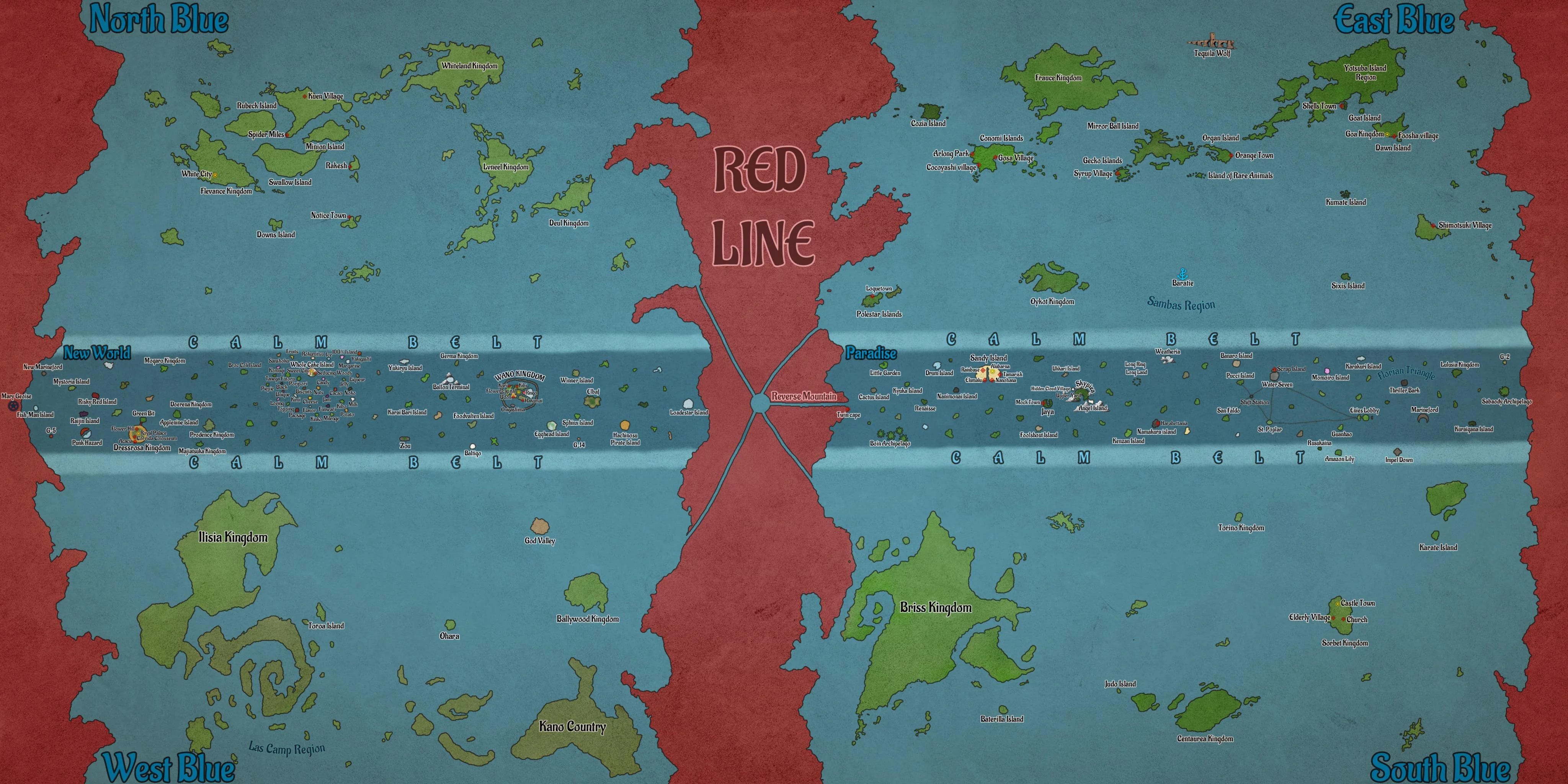
This approach requires a lot of effort, the series has to balance the infinite freedom of the setting with the expectations of the audience that each part of the story has to be coherent with the whole. How can you make a pre-historic island with dinosaurs feel coherent with a desert kingdom and a hyper futuristic paradise? This is a world that can accommodate all these disparate settings at once, plus islands floating in the clouds and an underwater mermaid kingdom.
To me, the most impressive part of the worldbuilding is how it ties into the core themes of the show—freedom and discovery. Later this month I’m going to talk about how One Piece represents the Romantic ideals, so I won’t get into much detail here, but I believe what makes this crazy story work is that it always feels authentic. There’s a genuine love for exploration and finding beauty in the world that infects the audience, it’s impossible not to have fun watching the characters sail across an impossible sea full of adventures.
Something that I also want to highlight is how mysterious the world is. There are many things that we still don’t know for sure about the past, and part of the joy of the series is putting together the lore of the Ancient Kingdom, figuring out what happened in the Void Century, and seeing how everything ties into this larger puzzle that the creator is laying out for us. Each arc gives us more pieces of the puzzle, but there’s still so much to find out. The sheer scale of this world and this story allows for infinite theories, which to me is part of the fun of any fantasy series.
I would be remiss if I didn’t include this wonderful fan-made video:
Fullmetal Alchemist: Brotherhood.
This is the second anime adaptation of Hiromu Arakawa’s manga Fullmetal Alchemist, and the show has solidified itself as one of the most popular and acclaimed anime of all time. Perhaps the biggest reasons why this show is so beloved is its tight plot and compelling characters, but more importantly for our discussion is how the story handles the limitations of magic.
In FMA:B, alchemy is the ability to change the properties of matter through a process called transmutation. While anyone can learn to do this, in order to perform a transmutation an alchemist needs to understand the element they are going to change on a molecular level, meaning that scientific knowledge is a prerequisite for alchemy which therefore limits how many people can become alchemists.
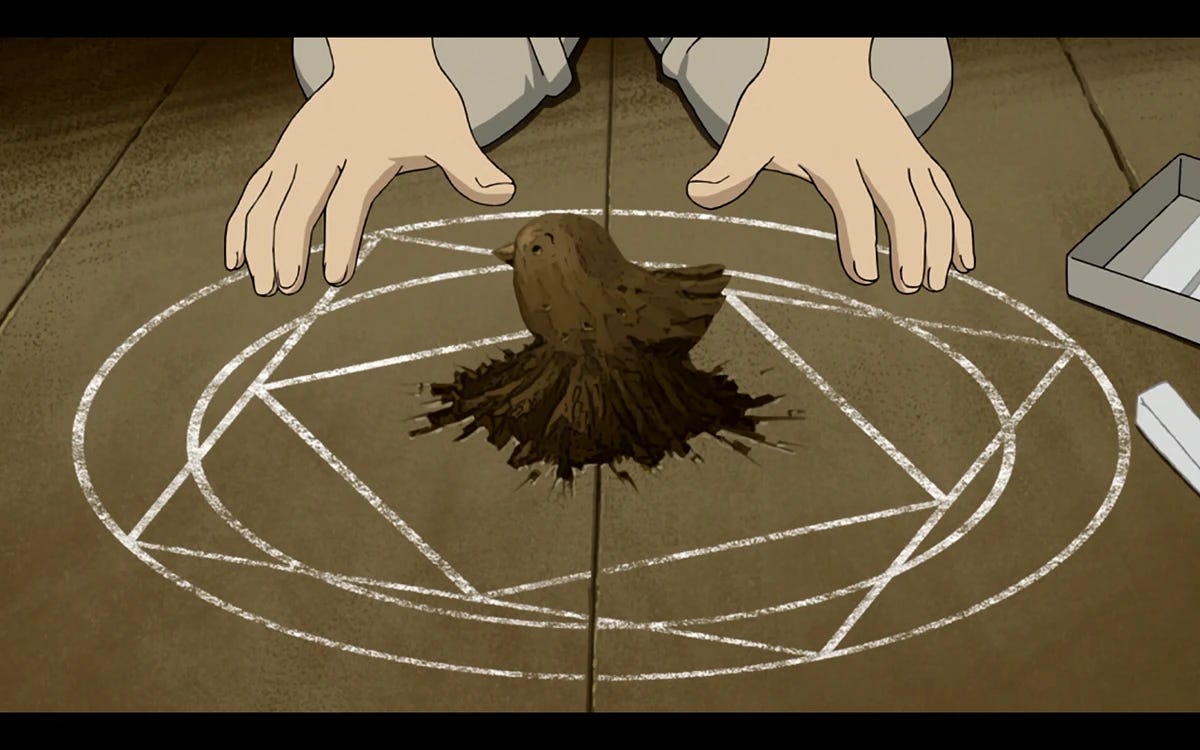
The guiding principle of alchemy is the Law of Equivalent Exchange, which determines that in order to obtain or create something, something of equal value must be lost or destroyed. This can be understood as the combination of two laws: The Law of Conservation of Mass (one kilogram of iron can be turned into a sword that weights one kilogram), and the Law of Natural Providence (an element can’t be turned into a completely different element, iron can’t be turned into gold).
The rules of alchemy are therefore a perfect example of what Brandon Sanderson calls the Three Laws of Magic:
An author’s ability to solve conflict with magic is directly proportional to how well the reader understands said magic.
Limitations > Powers.
Expand what you already have before you add something new.
The series explains the basic rules of alchemy from the beginning, so when the characters use alchemy to fight or to get out of trouble, we understand how they did it and can follow along. We know what they can and can’t do, we know the consequences of going against the rules, and the more we learn about different kinds of alchemy our understanding of the world expands without breaking any of the established laws. The magic system has enough room to accommodate different uses of magic, while being restricted enough that there can be no contradictions.
The few mysteries that the series has around alchemy are things that don’t break our immersion and actually tie into the main theme of the series: The limitations of humanity’s quest for knowledge. Alchemy is a science, but just like in the real world, there are things that we may never be able to know, and that’s okay.
Hunter x Hunter.
From the very beginning of this show we are told exactly what to expect: Strange beasts and monsters, vast riches, hidden treasures, evil haunts, uncharted frontiers. The Mysterious Unknown. Every arc we get deeper and deeper into this world of wonder and horror. I could talk about the Hunter organization, the magical places and creatures that we encounter, the genius of the Chimera Ants, or the insane amount of detail given to the mechanics of Greed Island. However, there’s one thing that I feel obligated to talk about more than anything else: the magic system, Nen, which is so detailed and complex it would make even Brandon Sanderson weep.
Nen is first shown in subtle ways, like Hisoka’s steel-sharp cards, before we are given a proper introduction to what it is and how it works. The general principles of Nen are easy enough to understand: everyone has life energy around them, you can learn to harness this energy through a couple of different methods, and each person can be classified into a specific Nen type. You can be a manipulator, a transmuter, an emitter, an enhancer, a conjurer, or a specialist. They are very self-explanatory. Once you know all the basics, we get to the fun part: How each person uses their Nen, which is known as their Hatsu.
Hatsu is where Nen truly shines. While there are rules for Nen as a whole, the way in which it can manifest is only limited by the users’ imagination. Hisoka, the resident creepy clown, simply turns his Nen into Bungee Gum, a substance that has the properties of both rubber and gum (heh). Meanwhile, my boy Knuckle’s power works by essentially giving his opponent a bad loan, and then accumulating interest throughout the fight, so the other person goes bankrupt and loses their Nen. There’s a guy that can make anything he writes real, so long as he writes it in haiku, and the better the haiku is, the stronger his Nen becomes.
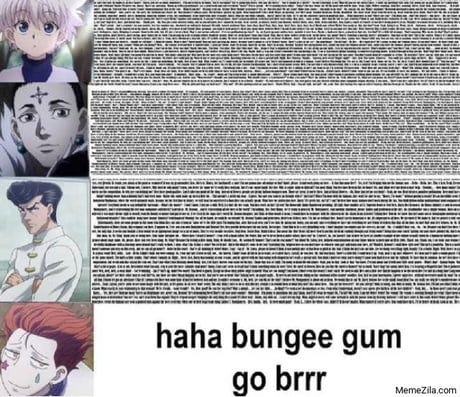
These are just the tip of the iceberg, the point is that Nen is the most versatile magic system I’ve ever seen in any fantasy series, not just in anime. There’s a reason why everyone who watches Hunter x Hunter tries to come up with their own techniques, it’s just very easy to follow the logic of the magic system and imagine what your Hatsu would be.
Nen is only one of the many examples of the amount of effort and care that the creator puts into each aspect of the worldbuilding, which is why Hunter x Hunter is a perfect example of what is sometimes called “hard” fantasy. In this world, rules and mechanics are everything.
Chainsaw Man.
Now we are going to talk about a completely different approach to worldbuilding.
More than anything else, the world of Chainsaw Man is ruled by fear. The series is set on an alternate version of Earth where humanity has to survive against the attacks of devils, which are the personification of our fears: the more we fear something, the stronger the devil becomes. We have the titular Chainsaw devil, the Gun devil, the Blood devil, etc. But there are also many devils that embody abstract concepts, like the Future or God (which manifests in the seemingly paradoxical Angel Devil).
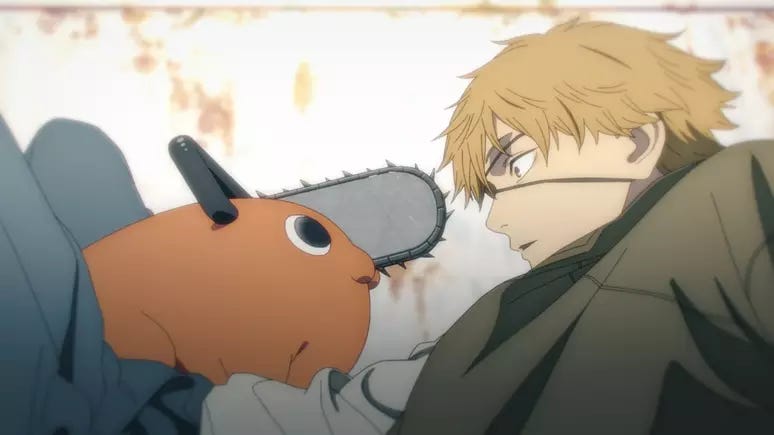
There are little rules about how the powers of these devils work, the only thing you really need to understand about this series is that fear is the source of their strength, and fears can’t die. To kill a devil is merely to send them back to hell, and they will come back eventually to haunt humanity. There’s one big exception to this, but that’s spoiler territory.
Chainsaw Man is an action series, but it’s also a supernatural horror story. The characters are literally fighting their fears, all the while they have to survive in a hostile world that treats people as objects and eventually destroys them. The biggest monster in the series is perhaps the world itself. This is why I love how the worldbuilding is not super complicated and filled with rules and mechanics, because ultimately there’s no reasoning with fear.
Re:ZERO — Starting Life in Another World.
The Isekai genre refers to any story about someone from one world being sent to a new one, which is commonly known outside of anime as portal fantasy (think of Narnia). Usually, the story revolves around someone from the “real” world being sent to a fantasy land, which most of the time involves dying. Isekai has been dominating anime for some years now, and every season has at least one new show about a perfectly normal guy that is sent to a magic kingdom full of beautiful Elf girls ready to fall in love with him. Re:Zero is one of the most popular series in this genre, and it happens to be one of my favorite shows. As you can imagine since I’m including it on this list, the setting is a big reason why.
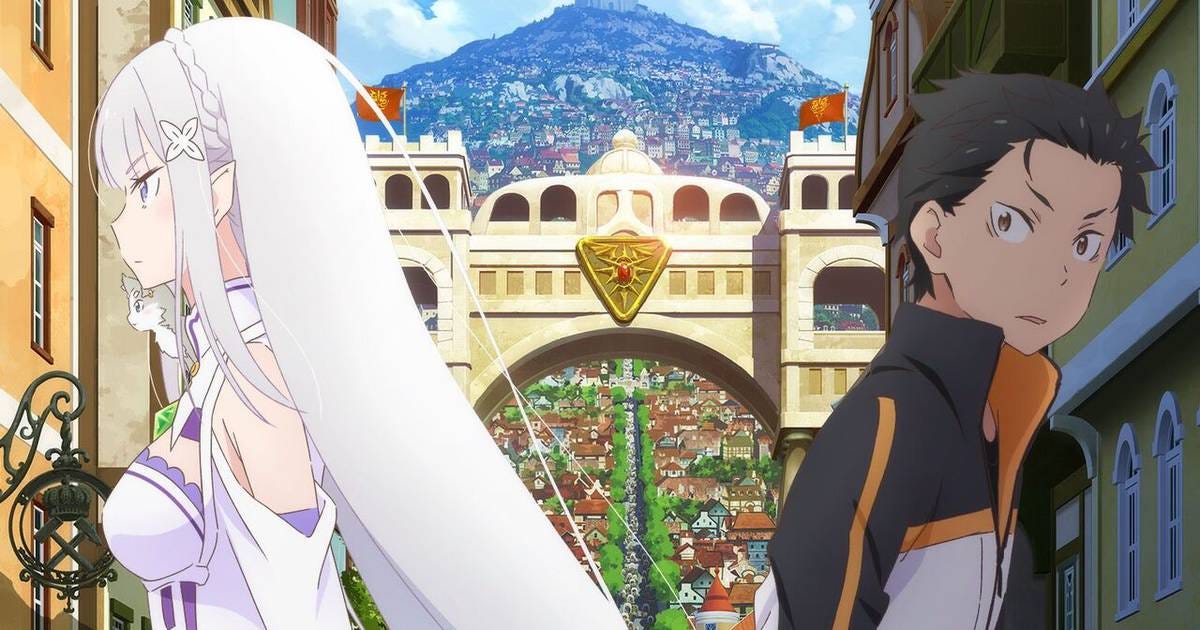
After our main character, a normal Japanese boy named Subaru, gets transported to the land of Lugunica, he immediately realizes what’s happening. He’s genre aware, he thinks he knows everything about how the story will play out and how the world functions. However, things are more complicated than he expects, and he actually has to put in the work to understand the world he’s plunged into.
For starters, Lugunica is a country undergoing big political changes, as the entire royal family is gone and the kingdom is looking for its next ruler. One of the main characters happens to be one of the candidates to become the next queen of Lugunica, and Subaru finds himself entangled in this political battle, all the while he has to survive against many literal battles against magical creatures, crazy assassins, and a religious cult that worships an evil witch (the witch that apparently brought Subaru to Lugunica). There’s a lot going on, and as the story progresses we get presented with more and more mysteries, slowly getting little hints about the deeper lore of the world.
One of the benefits of portal fantasy is that it provides an excuse for the main character to learn about the world. In Re:Zero, Subaru’s ignorance about the setting is not just a way to explain the worldbuilding, but also a source of conflict. His lack of knowledge about the political and social issues that plague the kingdom makes him commit grave mistakes, which often lead to his death. Because he has the unique ability to go back in time when he dies, he can spend as much time as needed figuring out what’s going on. If a magical beast shows up and wreaks havoc, Subaru has to go through several loops to find out how the beast operates and how to beat it. This way, the worldbuilding in Re:Zero becomes a central part of the story, and it makes this fantasy adventure also a mystery. In each arc, Subaru is presented with a series of puzzles that he has to solve, and even after he finds the solution, we still end up with more questions than we started with.
Even though portal fantasy gives the perfect opportunity for the author to drop some exposition on the audience, the lore drops in Re:Zero are quite subtle and natural. Subaru rarely sits down and asks for an explanation, and exposition is rare. Instead, Subaru (and the audience) has to pierce every background detail and every line of dialogue in order to gain knowledge about the world. This is a really bold approach, because it requires the audience to pay close attention all the time. Missing something can make you very confused later on, and that’s part of the fun of the show. I love the kind of worldbuilding that requires at least a couple Google searches and a deep dive into the fan wiki to fully understand.
When we think of fantasy, we often picture books with maps on the first page and hundreds of pages. However, the things we love about this genre don’t have to be restricted to literature. I believe fantasy fans can, and should, broaden their horizons beyond the written word, and experience this genre through new mediums. I would argue that visual media can bring new dimensions to fantasy, and while live action shows and movies are limited by budget and technological constraints, with animation you can get as many dragons and epic wizard battles as you want.
If your favorite part of fantasy is the worldbuilding, I can’t recommend these series enough. If you are familiar with any of these shows, what’s your opinion about their worldbuilding? What aspects of the setting are the most interesting to you?
Also, if you could take one fantasy series and make it an anime, which series would it be? Personally, I would love to get an anime version of A Song of Ice and Fire. It certainly can’t be worse than the adaptation we ended up with. I mean, just look at this beautiful fan-made animation:
Let me know which fantasy worlds are your favorites, either in literature or anime!
Thanks for reading! If you enjoy what I do but are not ready to become a paid subscriber, you can support me on Ko-Fi, where you can decide how much you want to pay. If you want to read my paid posts, consider subscribing for just $5 a month. Paid subscribers will receive at least 1 extra post each month, and my full reviews for finished series will be paid-only.
Let's read this after I finish the show. I wish there was a reminder tho ;)
I think Wheel of Time and Stormlight Archive would make great anime if done right. There's also a Lord of the Rings anime film releasing in December, which I'm cautiously hopeful for. A Game of Thrones anime could also work well, maybe as a remake of the last few seasons with George's input (since we probably won't get Winds of Winter).